What the year should cost, and what it actually did
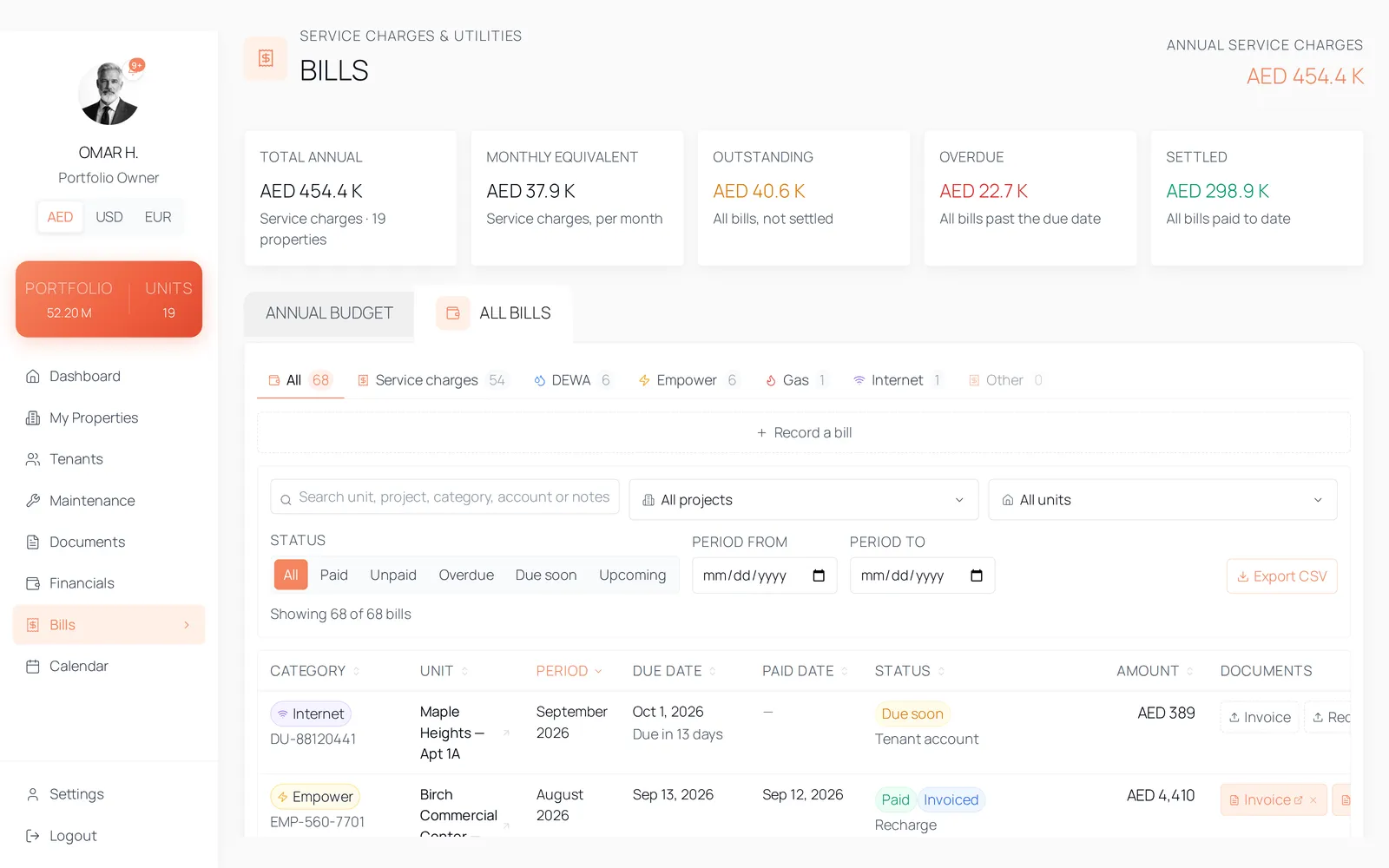
The annual service charge budget is built from the rate per square foot for every unit you hold, and the real invoices and receipts sit beside it period by period. The two are kept apart on purpose: one is a plan, the other is what was billed.
The cost that is easy to forget until it is late
- The annual service charge is known for the building and has never been worked out per unit.
- An invoice was paid in February and the receipt is in somebody's downloads folder.
- You find out a period was never billed when the next one arrives.
- The yearly cost of holding a unit is a figure you reconstruct at tax time instead of reading.
How it works
The budget comes from the rate and the area
Each project carries a service charge rate per square foot. Multiplied by a unit's area it gives that unit's annual charge, and a monthly figure with it. Where a unit has its own agreed amount, that override is used instead and the row says so, so an exception stays visible rather than disappearing into an average.
Billed periods are recorded separately
A real invoice is a period on the unit with its own dates, amount, due date and paid flag. The invoice and the receipt are attached to it in private storage, and a receipt may only exist on a period marked paid — proof of payment cannot sit on something unpaid.
Overdue and unbilled both raise themselves
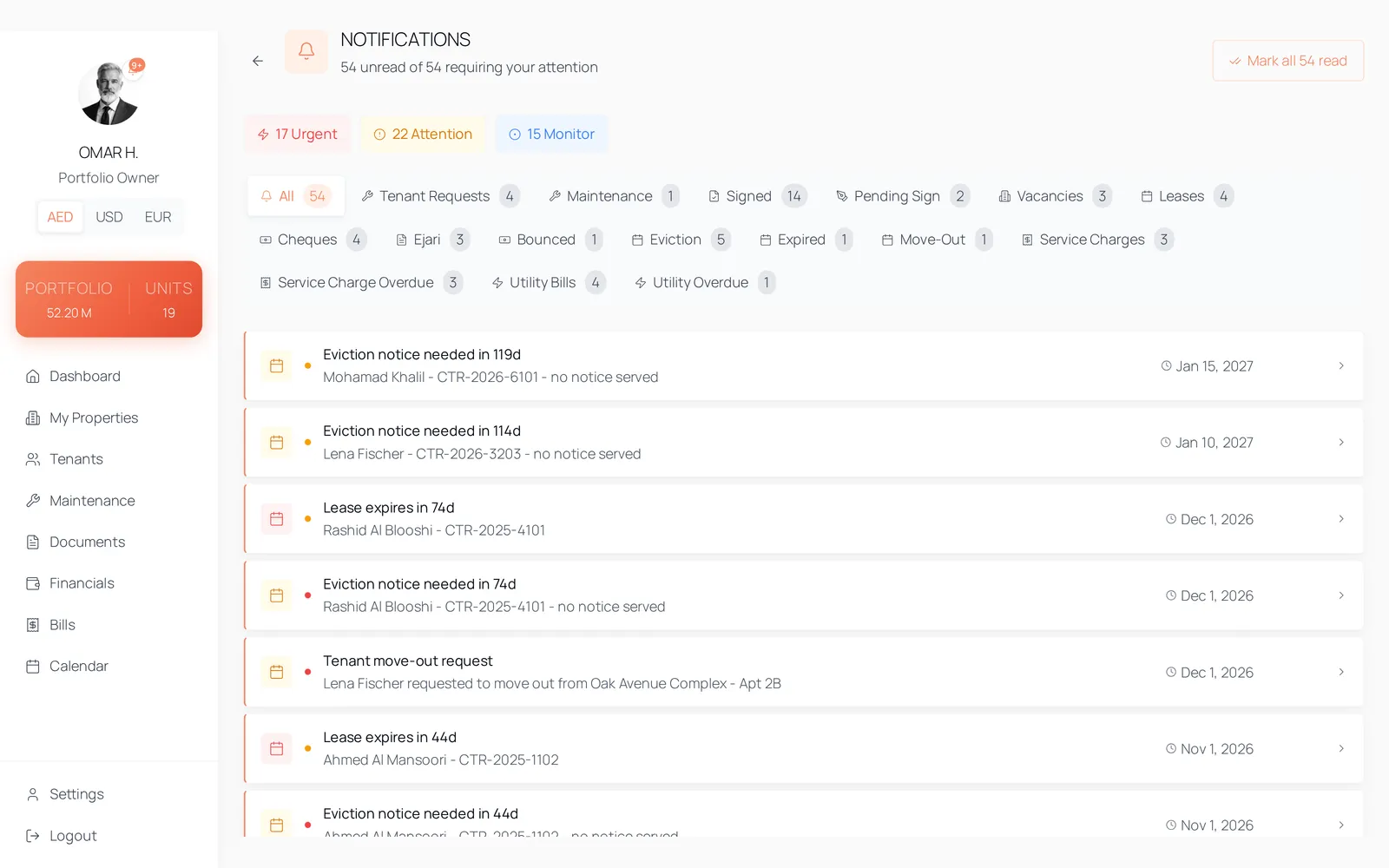
A period past its due date raises a high-priority overdue alert naming the number of days. A period approaching raises alerts at thirty, fifteen, ten, five, three, two and one day. A period whose dates have ended without a due date being set raises a quieter unbilled alert, which is the one that otherwise goes unnoticed for a year.
The details
- Budget
- Project rate per square foot × unit area, rounded, or the unit's own agreed amount where one is set. Monthly is the annual figure divided by twelve.
- Grouping
- By project, with the project type — villa, land or building — the developer and the rate carried on the group.
- Period status
- Derived: paid, overdue, due soon within thirty days, upcoming, or unpaid when no due date is set.
- Alert ladder
- 30, 15, 10, 5, 3, 2 and 1 days before the due date. Priority rises to medium inside ten days and high inside three.
- Attachments
- Invoice and receipt per period. A receipt is only accepted on a period marked paid.
- Where it lives
- The Bills page carries two tabs — Annual Budget and All Bills — and opens on whichever has something to act on.
- Deleting
- Restricted to owners in the database. A manager can create and settle a period but not erase one, and a refused delete is reported as such.
Questions
No. A service charge is an owner-side cost, and tenants are excluded from it in the database rather than in the interface.
See it with data in it
The demo opens instantly, in the role this workflow belongs to, on sample data. There is no account to create and no form in front of it.